Bottom line
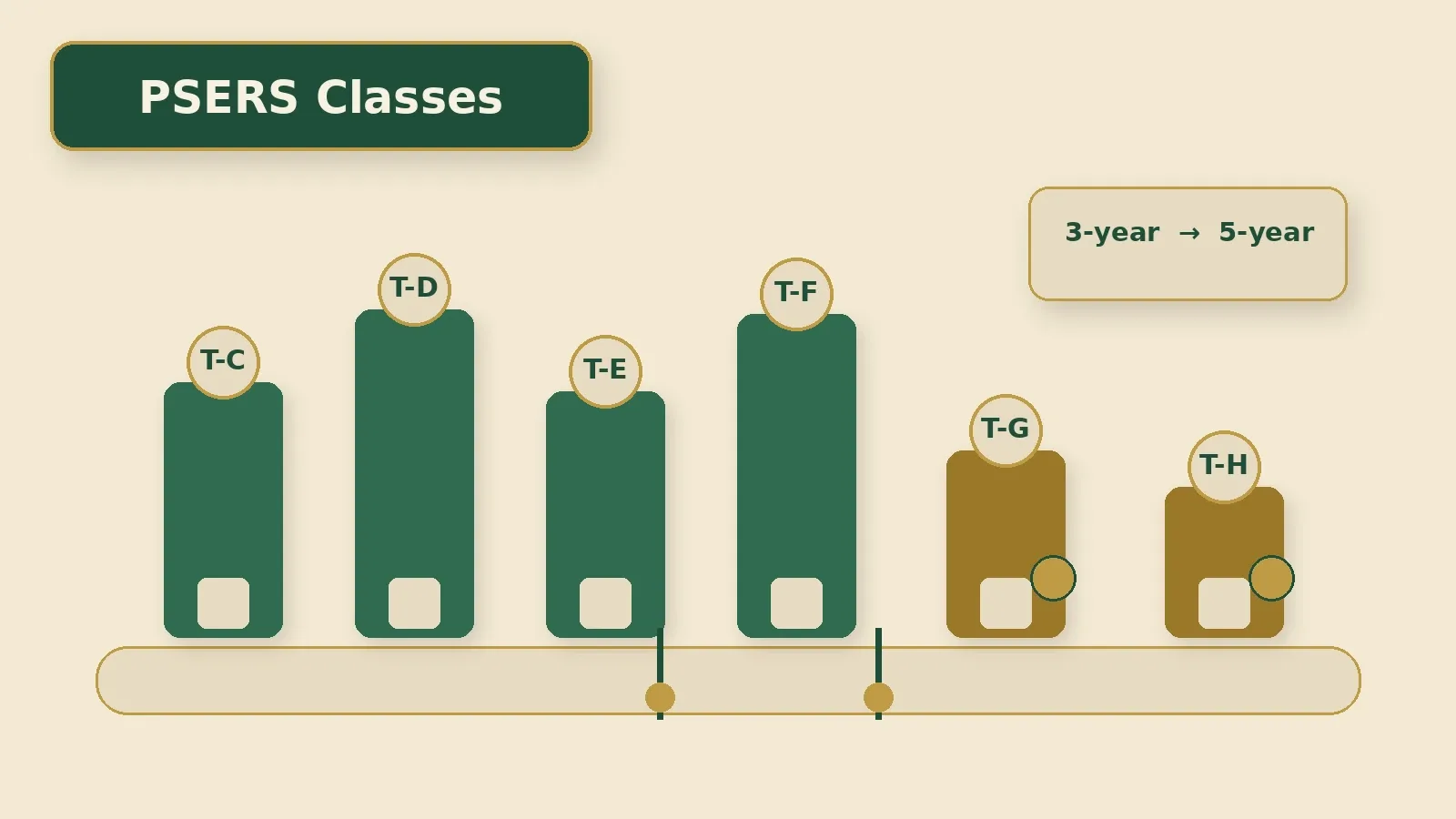
PSERS does not have a simple Tier 1/Tier 2 split. Membership classes changed across legislation: T-C/T-D are older DB classes, T-E/T-F began in 2011, and T-G/T-H hybrid classes began in 2019.Key facts
- July 1, 2011 is the effective start date for the T-E/T-F class structure created under Act 120.
- July 1, 2019 is the start date for new-member T-G/T-H/DC choices created by Act 5 of 2017.
- 2.5% is the DB multiplier generally associated with T-D/T-F, versus 2.0% T-C/T-E, 1.25% T-G and 1.0% T-H.
The useful comparison is membership class, not a generic Tier 1 versus Tier 2 label
PSERS currently spans several membership classes created under different Pennsylvania retirement laws. T-C and T-D are older defined-benefit classes. Act 120 introduced T-E and T-F for new membership beginning July 1, 2011. Act 5 of 2017 later created the T-G and T-H hybrid classes plus Class DC for people entering the system on or after July 1, 2019.
That history changes the planning questions. T-C through T-F are DB-only membership classes, while T-G and T-H combine a DB pension with a separate DC account. Class DC has only the DC plan. A teacher should identify the class on the PSERS Statement of Account before using any online pension formula, vesting rule or contribution table, because the same years of service can produce very different retirement structures.
Benefit multipliers and FAS periods became smaller or longer in the newer classes
PSERS' DB formula uses a class-specific multiplier. T-C and T-E generally use 2.0%; T-D and T-F generally use 2.5%; T-G uses 1.25%; and T-H uses 1.0%. The lower hybrid multipliers should not be viewed in isolation because T-G and T-H also receive DC contributions and investment earnings. Their retirement package deliberately combines a smaller guaranteed DB component with an account-based component.
Final Average Salary also changed. PSERS generally uses the three highest school-year salaries for T-C through T-F and the five highest for T-G and T-H. A five-year averaging period can reduce the impact of a late-career salary spike. These class differences mean that a colleague with the same salary and service can have a different formula pension simply because the person entered PSERS under a different membership class.
Contribution rates also vary by class and shared-risk rules
Current PSERS contribution tables show older fixed DB rates and newer classes with shared-risk/shared-gain provisions. For example, T-C contribution rates depend on continuous-employment history and are 5.25% or 6.25%, while T-D rates are 6.50% or 7.50%. T-E has a 7.50% DB base rate and T-F a 10.30% base rate, with shared-risk adjustments governed by the applicable review cycle.
For members on or after July 1, 2019, PSERS currently shows T-G with a 5.50% DB base plus 2.75% DC participant contribution, T-H with 4.50% DB plus 3.00% DC, and Class DC with 7.50% to the DC plan. The contribution split affects guaranteed pension accrual, individual-account funding and investment exposure, so comparing only the total payroll deduction can hide important differences.
Map the class timeline before comparing benefits
PSERS' class history is more useful than forcing the system into a two-tier model. T-C and T-D are legacy DB classes. Act 120 produced T-E and T-F for new membership beginning July 1, 2011. Act 5 of 2017 then changed the structure for new members beginning July 1, 2019 by creating T-G, T-H and Class DC.
Class determines formula, contribution rules, vesting and whether the member has a DC account. A teacher who changes school districts but remains continuously in PSERS usually does not simply become a newer class because the employer changed. The membership record, entry date and any valid class election control. Use the latest PSERS statement to identify the class before comparing another employee’s retirement outcome.
| Class group | General era / structure |
|---|---|
| T-C / T-D | Older DB-only classes |
| T-E / T-F | Act 120 classes from Jul. 1, 2011 |
| T-G / T-H | Act 5 hybrid classes from Jul. 1, 2019 |
| Class DC | Act 5 DC-only elective class |
Compare formula pension first, then add any DC account
T-D and T-F generally have the largest 2.5% DB multiplier, T-C and T-E use 2.0%, T-G uses 1.25%, and T-H uses 1.0%. A raw formula comparison makes the hybrid classes appear smaller because it leaves out their DC accounts. The correct comparison adds the account-based component for T-G/T-H and treats Class DC as entirely account based.
FAS also changed from three highest school years for T-C through T-F to five highest years for T-G and T-H. A newer hybrid member therefore combines a lower DB multiplier, a longer FAS averaging period and a DC account. Those changes redistribute retirement risk between the guaranteed pension and investments rather than simply reducing one identical benefit.
| Class | DB multiplier | FAS | DC |
|---|---|---|---|
| T-C | 2.0% | 3 years | No |
| T-D | 2.5% generally | 3 years | No |
| T-E | 2.0% | 3 years | No |
| T-F | 2.5% | 3 years | No |
| T-G | 1.25% | 5 years | Yes |
| T-H | 1.0% | 5 years | Yes |
Contribution rates reflect the different benefit designs
Current employee contributions vary by class. Legacy T-C/T-D rates depend partly on continuous-employment history. T-E and T-F have DB base rates subject to shared-risk/shared-gain adjustments. T-G and T-H split contributions between DB and DC components, while Class DC directs the member contribution to the DC plan instead of a formula pension.
Contribution percentage should therefore be interpreted together with what the member is buying. A higher DB contribution can support a higher formula multiplier and guaranteed lifetime pension; a higher DC contribution builds a larger individual account but leaves investment results with the participant. The class-election article is the right place to compare the three current options for new members, while this class article explains how Pennsylvania's benefit design changed over time.
| Class | Current structure |
|---|---|
| T-C/T-D | Fixed DB rates tied to employment history |
| T-E/T-F | DB base + shared risk/gain |
| T-G | DB base 5.50% + DC 2.75% |
| T-H | DB base 4.50% + DC 3.00% |
| Class DC | DC 7.50% |
Before you act on this
- Identify the membership class on the PSERS statement.
- Match the class to its DB multiplier and FAS period.
- Check whether the class has a separate DC component.
- Use the current PSERS contribution table instead of an old handbook rate.
- Do not apply another class's vesting or retirement rule to your account.
Common questions
What are the different PSERS membership classes?
PSERS currently includes legacy DB classes T-C and T-D, Act 120 classes T-E and T-F, Act 5 hybrid classes T-G and T-H, and Class DC. The classes differ in pension multiplier, Final Average Salary period, contribution structure, vesting and whether retirement includes a separate Defined Contribution account.
When did PSERS Class T-E and T-F begin?
PSERS history shows that Act 120 created the T-E and T-F class structure for new membership beginning July 1, 2011. Both are DB-only classes, but T-E generally uses a 2.0% multiplier while T-F uses 2.5% and has a higher member contribution rate.
When did PSERS T-G and T-H start?
Act 5 of 2017 created T-G, T-H and Class DC for the new-member system beginning July 1, 2019. The T-G and T-H designs combine a formula pension component with a separate Defined Contribution account. Class DC is defined-contribution only and does not provide the normal PSERS formula pension.
Which PSERS class has the highest pension multiplier?
T-D and T-F generally use the highest listed DB multiplier at 2.5%. T-C and T-E use 2.0%, T-G uses 1.25%, and T-H uses 1.0%. A multiplier-only comparison is incomplete for T-G and T-H because those hybrid classes also receive a separate DC account.
Is PSERS really a Tier 1 and Tier 2 system?
Not in the simple way some pension systems are. PSERS uses named membership classes created under different legislation. The useful comparison is T-C/T-D versus T-E/T-F versus the newer T-G/T-H/DC structure. Using a generic Tier 1/Tier 2 label can hide important class-specific formula and contribution rules.
Sources for this page
Sources were reviewed on September 2, 2026. Rules and member records maintained by the retirement system control.
PSERS — Contributions by Membership ClassOfficial source ↗PSERS — HistoryOfficial source ↗PSERS — Retirement Estimate Calculator HelpOfficial source ↗General educational information only — this is not a formal benefit determination, nor financial, tax, or legal advice. Verify anything account-specific with the retirement system itself.