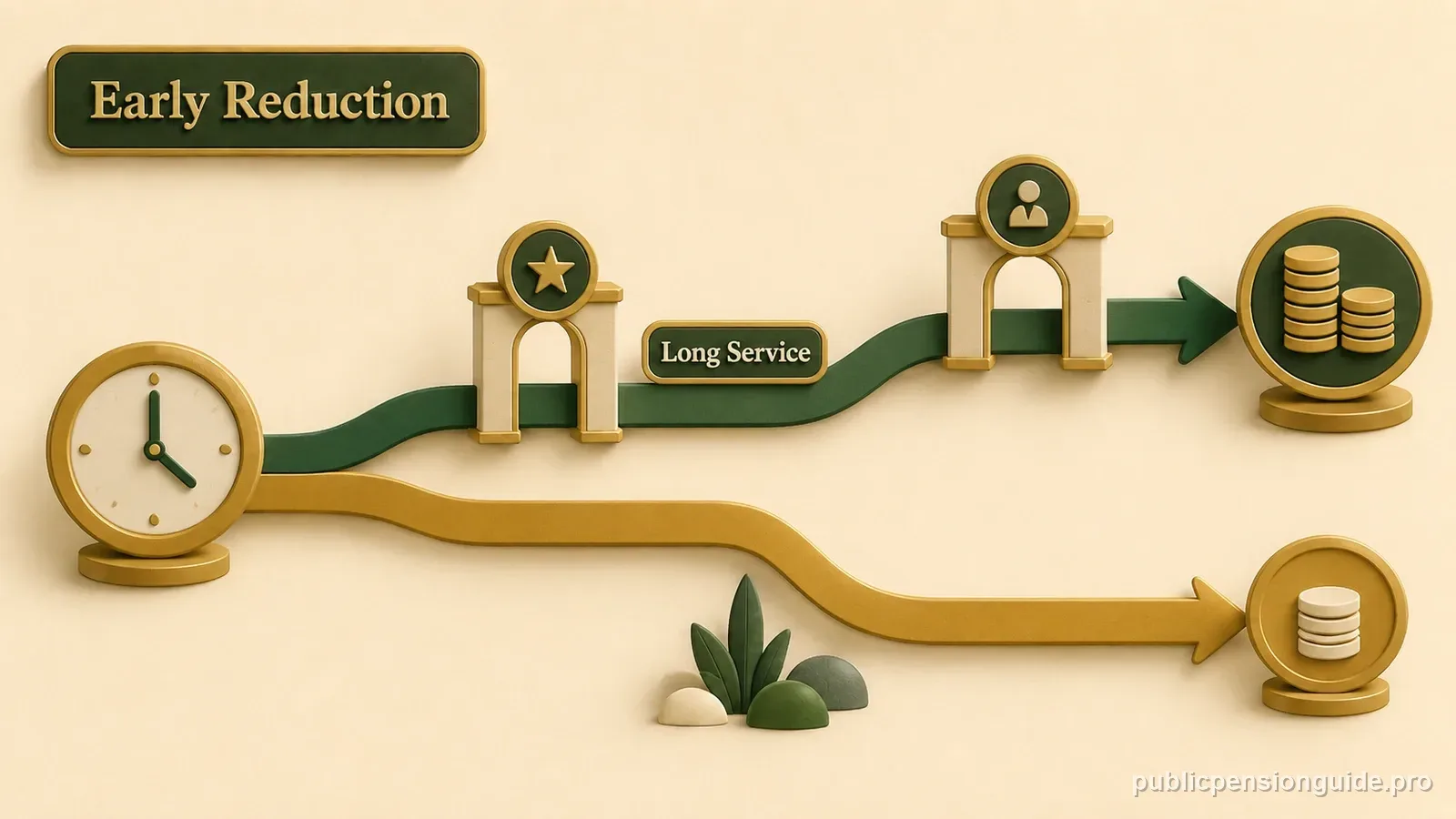
The gist
Standard PSERS early retirement is actuarially reduced and can be substantial. Special early retirement uses 55/25 for most DB classes, while T-G uses a 57/25 milestone.Key facts
- 4%–7% per year is PSERS' current approximate range for standard early-retirement reduction from the nearest normal-retirement point.
- 0.25% per month is the special early-retirement reduction used for the 55/25 framework described by PSERS.
- 57 years old with 25 years of service is the special early-retirement milestone for Class T-G.
Standard early retirement uses an actuarial reduction rather than one flat penalty
A vested PSERS member who begins the DB pension before normal-retirement eligibility can receive a reduced benefit. PSERS describes the standard reduction as actuarially equivalent: the monthly amount is lowered because payments are expected to be made over a longer period. Its 2025–26 educational materials describe a typical reduction of approximately 4% to 7% per year for each year away from the nearest normal-retirement point.
That 4%–7% range is not a universal formula to multiply blindly. The actual factor depends on class, age, service and distance from normal retirement. PSERS specifically notes different reduction treatment for T-G and T-H members retiring before age 62 with less than 25 years of service. For a decision within 12 months, PSERS recommends a staff-prepared estimate rather than relying only on a generic calculator.
Special early retirement can soften the penalty when service is long
For Classes T-C, T-D, T-E, T-F and T-H, PSERS offers the 55/25 special early-retirement route when the member is at least age 55 and has at least 25 years of credited service. PSERS describes the reduction as one quarter of one percent per month for each month the member is below the applicable normal-retirement requirement, which corresponds to 3% per year.
PSERS educational material also states caps for some older classes: the special reduction can be capped at 15% overall for T-C and T-D and 30% for T-E and T-F. A member should not assume the same cap applies to every class. The special rule must be matched to the actual membership class and retirement date shown in the system estimate.
Class T-G has a separate 57/25 special milestone
Class T-G does not use the same age-55 entry point. PSERS lists a special early-retirement milestone at age 57 with 25 years of service. Because T-G is a hybrid class, the early-retirement reduction applies to the DB component; the DC account remains an account-based benefit whose value and distribution timing follow separate DC rules after termination.
The practical comparison is therefore broader than one reduced monthly pension. A T-G member deciding whether to leave at 57 should compare the reduced DB benefit, the DC account, continued salary, future service credit and the possibility of reaching the Rule of 97 later. Starting a reduced DB benefit earlier creates lifetime cash flow sooner, but it can permanently lower the monthly DB payment.
Standard early retirement can create a large permanent reduction
PSERS describes the standard early-retirement factor as actuarially equivalent to the normal benefit, which means the monthly pension is lowered to account for a longer expected payment period. Its current educational material gives an approximate range of 4% to 7% per year for each year the member is away from the nearest normal-retirement point.
That range should be treated as a planning signal, not a final multiplier. A member five years from normal retirement could see a materially different result depending on class, age and service. The best comparison uses two PSERS estimates with the same salary assumptions: one at the proposed early date and another at the nearest unreduced date.
| Route | General treatment |
|---|---|
| Standard early retirement | Actuarial reduction; roughly 4%–7% per year in PSERS education material |
| Special 55/25 | 0.25% per month below normal requirements for listed classes |
| T-G special route | Age 57 with 25 years |
55/25 special early retirement is class-limited
Classes T-C, T-D, T-E, T-F and T-H can use the special 55/25 route after reaching age 55 with at least 25 years of credited service. PSERS describes the special reduction as one quarter of one percent per month below the applicable normal-retirement requirement. That equals 3% per year and can be more favorable than the standard actuarial reduction.
PSERS materials also describe overall caps of 15% for T-C/T-D and 30% for T-E/T-F under the special rule. Because T-H and T-G entered later systems and do not map perfectly to those older caps, members should use the current system estimate rather than extending a cap from another class. The special route changes the reduction formula, not the underlying benefit multiplier.
| Class | Milestone |
|---|---|
| T-C / T-D / T-E / T-F / T-H | Age 55 + 25 years |
| T-G | Age 57 + 25 years |
T-G hybrid members must compare the reduced DB with the separate DC account
T-G's special milestone is age 57 with 25 years rather than age 55. Early-retirement rules apply only to the DB component for T-G and T-H hybrid members. The separate DC account follows its own distribution rules after termination. That means an early-retirement decision can produce a reduced lifetime DB payment while the DC account remains available for rollover or other permitted distributions.
A useful comparison shows annual salary forgone, new service credit forgone, the permanent DB reduction and the DC account value at each date. Waiting can improve the formula pension through more service and possibly a higher FAS, while also allowing more DC contributions and investment time. Starting earlier provides income sooner.
| Component | At early retirement |
|---|---|
| DB pension | May be permanently reduced |
| DC account | Separate vested account distribution rules |
| Salary | Stops when employment terminates |
| Future service | No additional credit after leaving |
Compare the reduction with the value of another year worked
An early-retirement percentage should be compared with the salary and benefits earned by continuing employment. Waiting one year can add service credit, possibly improve FAS, reduce the early-retirement factor and add another year of DC contributions for a hybrid member. Those four effects can make the difference larger than the headline reduction percentage alone suggests.
At the same time, delaying retirement means giving up a year of pension payments that could have started earlier. A break-even analysis can compare cumulative pension received under the early date with the higher monthly amount under the later date. Because life expectancy and investment assumptions are personal, the article should present the mechanics without pretending one date is universally better.
| Early date | Later date |
|---|---|
| Pension starts sooner | Higher monthly pension likely |
| Less service/FAS growth | More service/FAS potential |
| Lower hybrid DC contributions | Additional hybrid DC contributions |
Before you act on this
- Identify the nearest normal-retirement point for your class.
- Request an early-date and unreduced-date estimate using the same assumptions.
- Check whether you qualify for 55/25 or the T-G 57/25 route.
- Separate DB reduction from DC distribution planning for hybrid classes.
- Compare lifetime monthly income, not only the first-year cash flow.
Questions people ask
How much does PSERS reduce a standard early pension?
PSERS educational materials describe the standard early-retirement reduction as approximately 4% to 7% per year for each year away from the nearest normal-retirement point. The exact actuarial factor depends on class, age and service and is not a single universal percentage. Request a PSERS estimate for the actual proposed date.
What is the PSERS 55/25 rule?
Classes T-C, T-D, T-E, T-F and T-H can qualify for special early retirement at age 55 with at least 25 years of credited service. PSERS describes the reduction as one quarter of one percent per month below the normal-retirement requirement, equivalent to 3% per year.
Does PSERS Class T-G use 55/25?
No. PSERS lists a separate special early-retirement milestone for Class T-G at age 57 with 25 years of service. T-G is a hybrid class, so the early-retirement reduction applies to the DB component while the separate DC account follows its own distribution provisions after termination.
Is the PSERS standard early-retirement reduction capped?
PSERS states that the standard actuarial early-retirement reduction has no general cap. Special 55/25 rules can have different limits for certain classes, including published caps for T-C/T-D and T-E/T-F. The applicable class must be identified before using a cap from an educational example.
Can I avoid the early-retirement reduction by leaving but delaying the pension?
A vested member can generally defer the PSERS DB pension after terminating employment. Waiting until a later normal-retirement point can reduce or eliminate the age penalty, subject to the class rules. Deferral is different from continuing to work because no additional school service or salary is earned after employment ends.
Official sources
Sources were reviewed on September 2, 2026. Rules and member records maintained by the retirement system control.
PSERS — RetiringOfficial source ↗PSERS — Nearing RetirementOfficial source ↗PSERS — 2025–26 Foundations for Your FutureOfficial source ↗General educational information only — this is not a formal benefit determination, nor financial, tax, or legal advice. Verify anything account-specific with the retirement system itself.