The gist
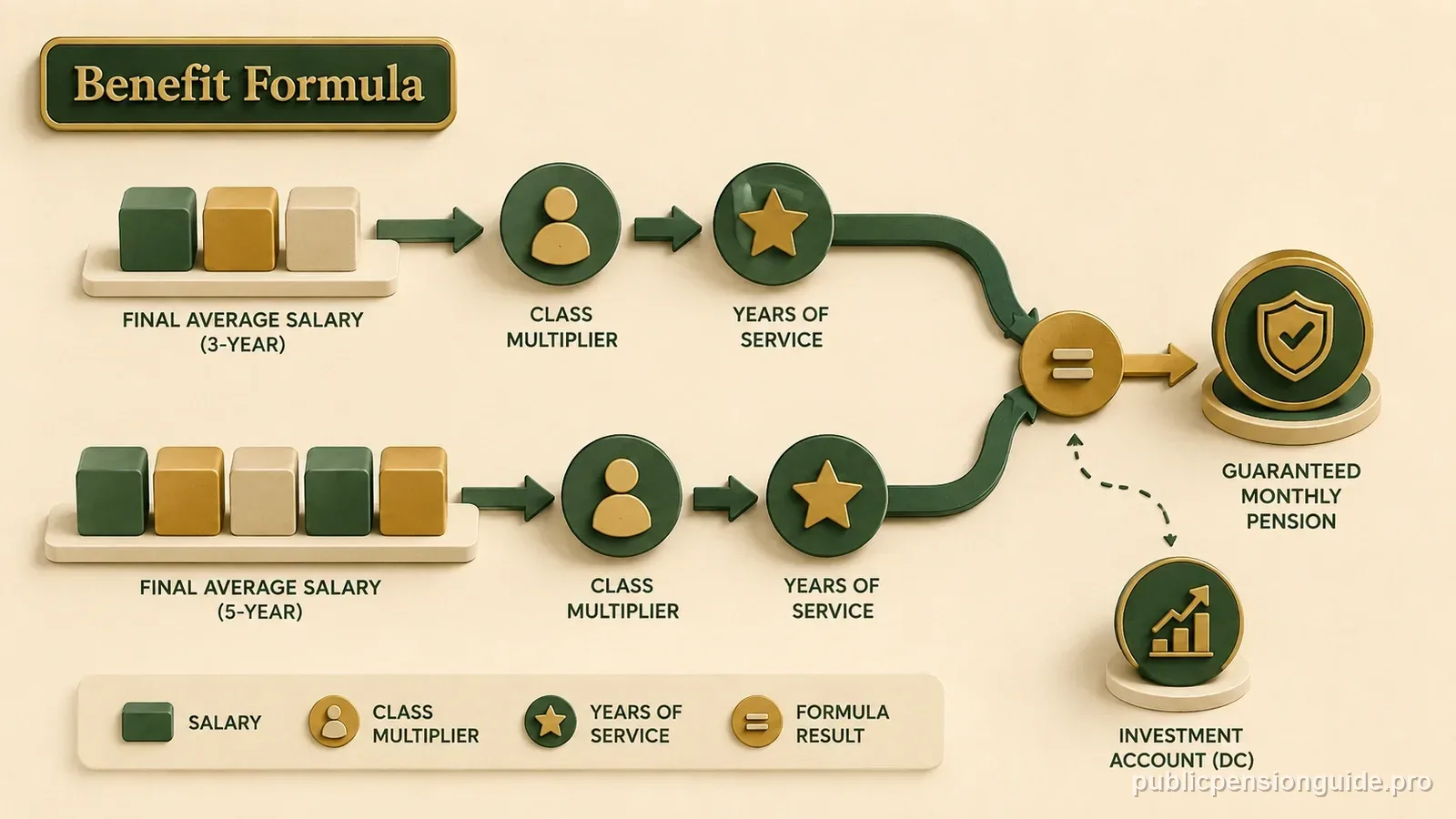
The PSERS DB formula is Final Average Salary × class multiplier × credited service. The multiplier and FAS period change by class, and T-G/T-H also have a separate DC account.Quick facts
- 2.5% is the DB multiplier for Classes T-D and T-F, subject to special T-D rules for non-school service.
- 1.25% is the DB multiplier for Class T-G; the member also receives the vested value of the DC component.
- 5 years of highest salaries generally determine FAS for Classes T-G and T-H, versus 3 years for T-C through T-F.
Use the class multiplier that matches the member’s service
PSERS calculates the annual Maximum Single Life Annuity for the DB component by multiplying Final Average Salary, the membership-class multiplier and credited service. Class T-C and T-E use a 2.0% multiplier. Class T-D and T-F generally use 2.5%. Class T-G uses 1.25%, and Class T-H uses 1.0%. Those differences can materially change the DB portion even when salary and service are identical.
Class T-D has an important nuance: PSERS explains that the higher 2.5% multiplier applies to school service, while certain non-school service can use a 2.0% multiplier. That is one reason a hand calculation can diverge from the official estimate when the record contains purchased out-of-state, government, maternity or other non-school service. The PSERS calculator or a staff estimate should be used for mixed-service records.
Final Average Salary uses three years for older classes and five for T-G/T-H
PSERS says the Final Average Salary for Classes T-C, T-D, T-E and T-F is generally based on the average of the three highest school-year salaries. For Classes T-G and T-H, the FAS is generally the average of the five highest school-year salaries. A longer averaging window can dampen the effect of a late-career salary jump because more years are included in the calculation.
The Statement of Account is a useful source for reviewing salary and service data before building an estimate. PSERS tells members to resolve reporting discrepancies with the employer because employer-submitted salary and service feed the retirement calculation. An estimate built on an incorrect year of salary or missing credited service can look mathematically correct while still producing the wrong pension.
A worked example shows the DB formula but not the entire hybrid benefit
Suppose a Class T-G member retires with a five-year FAS of $80,000 and 30 years of credited service. The basic DB calculation is $80,000 × 1.25% × 30, which equals $30,000 per year before any early-retirement, payment-option or withdrawal adjustment. Dividing by 12 gives a rough $2,500 monthly DB amount before those reductions.
That $30,000 example is only the DB component. Class T-G and T-H members also have a PSERS DC account whose value depends on participant and employer contributions, investment performance, fees and distribution choices. Class DC members have no DB formula at all. For a hybrid member, a complete retirement projection needs both the formula-based monthly benefit and the current DC account value.
Multiplier table by class
The class multiplier is the first number to verify when a pension estimate looks surprising. T-C and T-E use 2.0%; T-D and T-F generally use 2.5%; T-G uses 1.25%; and T-H uses 1.0%. Newer hybrid classes deliberately have smaller DB multipliers because part of the retirement package is being funded in the separate DC account.
Do not compare a T-G pension estimate with a T-F estimate without also adding the T-G DC value. The DB formula alone makes T-G appear much smaller, but it is only one component of the hybrid benefit. Likewise, Class DC members have no formula-based pension. Their retirement value comes from the vested DC account and investment results.
| Class | DB multiplier | DC component |
|---|---|---|
| T-C | 2.0% | No |
| T-D | 2.5% generally | No |
| T-E | 2.0% | No |
| T-F | 2.5% | No |
| T-G | 1.25% | Yes |
| T-H | 1.0% | Yes |
Final Average Salary and service inputs
For T-C through T-F, PSERS generally averages the three highest school-year salaries for FAS. T-G and T-H generally use the five highest school-year salaries. That means identical final salaries can produce different FAS values if compensation climbed quickly near retirement. Verify the actual highest-year sequence on the PSERS record rather than substituting the last three or five calendar years.
Credited service also needs to match what PSERS has recorded. Full-time and part-time service, purchased credit and non-school service can affect the total and, in some cases, the multiplier applied to a particular segment. T-D is the clearest example because PSERS distinguishes school service eligible for 2.5% from certain non-school service that can use 2.0%.
| Class | General FAS period |
|---|---|
| T-C / T-D / T-E / T-F | 3 highest school years |
| T-G / T-H | 5 highest school years |
Worked formula example for Class T-G
With an $80,000 FAS and 30 years of credited service, the Class T-G DB formula produces $80,000 × 0.0125 × 30 = $30,000 as an annual Maximum Single Life Annuity before other adjustments. The rough monthly equivalent is $2,500. An early-retirement factor, survivor payment option or withdrawal of contributions can lower the monthly amount.
The hybrid retirement is larger than that DB figure alone because T-G also includes the vested DC account. The account's future value cannot be derived from the DB formula: it depends on contributions, investment performance, fees and distribution choices. A retirement estimate should therefore show the $30,000 formula result and a separate current or projected DC balance rather than blending them into one unexplained number.
| Input | Example |
|---|---|
| FAS | $80,000 |
| Multiplier | 1.25% |
| Service | 30 years |
| Annual DB before adjustments | $30,000 |
| Approx. monthly DB before adjustments | $2,500 |
Reconcile the hand calculation with the official estimate
After calculating the basic MSLA, compare it with the official PSERS estimate line by line. Differences often come from early-retirement factors, payment options, contribution withdrawals or mixed service rather than the basic multiplier itself. For hybrid members, verify that the DC balance is displayed separately and is not being mistaken for part of the guaranteed monthly benefit.
Use the hand formula to understand sensitivity: another year of service increases the raw DB by one additional multiplier times FAS, while a higher FAS raises every credited year. That makes it easier to understand why working one more year can change the estimate through both service and salary, even before any early-retirement factor changes.
| Difference | Check |
|---|---|
| Lower official monthly amount | Early factor/payment option/withdrawal |
| Unexpected multiplier | Membership class or T-D service type |
| Different salary base | Three- vs five-year FAS |
| Hybrid total | Separate DB and DC components |
Checklist before you decide
- Confirm your membership class and multiplier.
- Verify the correct three- or five-year FAS period.
- Reconcile credited service with the latest PSERS record.
- Apply any early-retirement or payment-option reduction separately.
- Add the DC account separately for T-G or T-H.
Common questions
What is the basic PSERS pension formula?
For the Defined Benefit component, PSERS uses Final Average Salary × membership-class multiplier × credited service to produce the annual Maximum Single Life Annuity before applicable reductions or payment-option adjustments. The multiplier and FAS period depend on class, and T-G/T-H members also have a separate Defined Contribution account.
What multiplier does PSERS Class T-D use?
PSERS generally uses a 2.5% multiplier for Class T-D school service. The system notes that certain non-school service can use a 2.0% multiplier instead. Members with purchased out-of-state, government, maternity or other non-school service should use the PSERS estimate rather than applying 2.5% to every service year.
How is Final Average Salary calculated in PSERS?
PSERS generally averages the three highest school-year salaries for Classes T-C, T-D, T-E and T-F. Classes T-G and T-H generally use the five highest school-year salaries. The highest years are not necessarily the last years, so the Statement of Account and employer reporting should be checked for accuracy.
Does the Class T-G pension formula include the DC account?
No. Class T-G has a hybrid retirement. Its DB component uses a 1.25% multiplier and a five-year FAS, while the DC account is separate and depends on contributions, investment performance, fees and distribution choices. A complete T-G estimate therefore combines a formula pension with a separately valued DC account.
Why can my PSERS estimate be lower than a hand calculation?
A hand calculation may omit an early-retirement factor, a survivor payment option, a contribution withdrawal, mixed T-D service multipliers or corrections to salary and service. Hybrid members may also compare only the DB component. Use Member Self-Service or a staff-prepared estimate when the retirement decision is close.
Sources for this page
Sources were reviewed on September 2, 2026. Rules and member records maintained by the retirement system control.
PSERS — Estimate Calculator HelpOfficial source ↗PSERS — Statement of AccountOfficial source ↗PSERS — New to PSERSOfficial source ↗This article provides general educational information. It is not a benefit determination or financial, tax, or legal advice. Confirm account-specific information with the retirement system.