Short answer
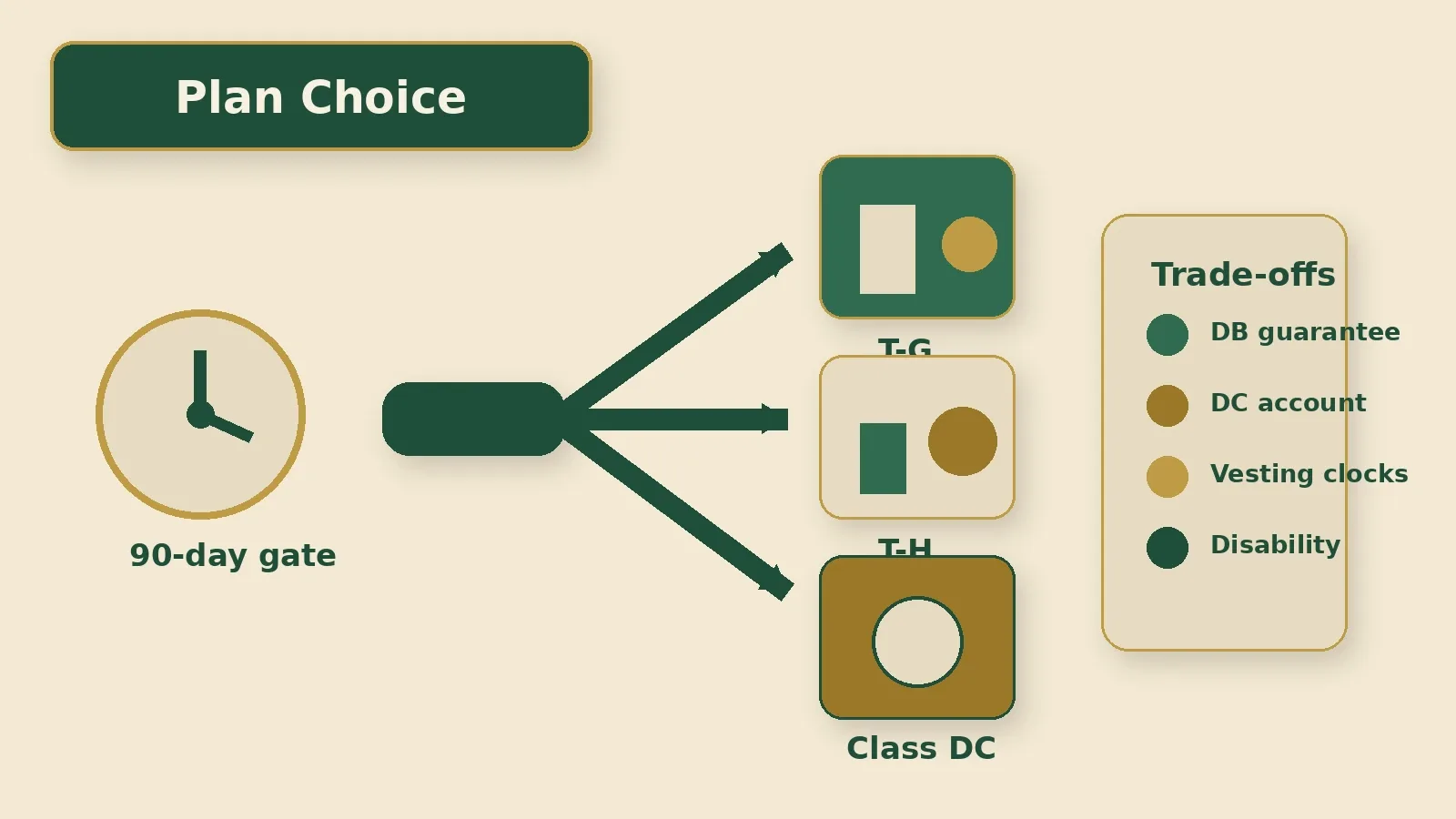
New PSERS members starting on or after July 1, 2019 default to T-G and have 90 days to elect T-H or Class DC. The election is irrevocable, so compare guaranteed DB income with DC exposure before the deadline.Quick facts
- 90 days is the class-election period for eligible new PSERS members.
- 8.25% is the current total member contribution shown for T-G, versus 7.50% for T-H and Class DC.
- 2.25% is the employer DC contribution for T-G, versus 2.00% for T-H and Class DC.
Doing nothing is a decision because T-G is the default membership class
PSERS automatically enrolls a new active member entering on or after July 1, 2019 in Class T-G. The member then has a 90-day election period to remain in T-G or choose T-H or Class DC. No form is required to stay T-G. PSERS describes the class election as irrevocable, so missing the deadline does not preserve an option to switch later when investment markets or career plans change.
T-G and T-H are hybrid classes. Both include a formula-based DB pension and a separate DC account, but T-G puts more member contribution toward the DB component and provides a higher DB multiplier. Class DC removes the DB pension entirely and bases retirement value on the vested account balance, contributions, investment results, fees and distribution choices. The decision changes both guaranteed income and investment risk.
Current contribution splits help show what each class is buying
PSERS currently lists total member contributions of 8.25% for T-G, made up of a 5.50% DB base and 2.75% DC contribution. T-H totals 7.50%, split between a 4.50% DB base and 3.00% DC contribution. Class DC contributes 7.50% entirely to the DC plan. Shared-risk/shared-gain provisions can alter the DB contribution for the hybrid classes within statutory limits.
Employer money going directly to the member’s DC account is also different. PSERS lists 2.25% for T-G and 2.00% for T-H or Class DC. That does not mean employer pension cost ends at those percentages; it is specifically the DC-account contribution credited to the member. Compare account funding and DB accrual together rather than choosing the option with the largest single DC percentage on the page.
Class DC trades away DB guarantees and several pension-system features
PSERS' class-election material emphasizes that Class DC provides no monthly defined-benefit pension. It also does not provide PSERS disability retirement, and Class DC members cannot purchase service credit or elect Multiple Service membership to combine PSERS and SERS credited service. Those differences can matter more than the investment account for a teacher who expects a long Pennsylvania public career or values disability protection.
T-G and T-H DB benefits generally require ten years of service to vest, with an age-67-and-three-years alternative under current rules, while employer DC contributions vest after three eligibility points. A short-career teacher may therefore value the faster DC vesting and portability differently from someone expecting decades in the system. The 90-day decision should be based on expected career length, risk tolerance and benefit features, not a prediction of near-term market returns.
Use the 90-day window to decide how much guaranteed pension versus investment exposure you want
T-G is the default because no action is required to remain in it. It provides the largest DB component of the three current new-member choices and also includes a DC account. T-H keeps both components but shifts somewhat more of the member contribution toward DC and uses a smaller DB multiplier. Class DC eliminates the guaranteed formula pension entirely.
The decision is not simply conservative versus aggressive investing. T-G/T-H also provide access to pension-system features tied to the DB component, such as disability retirement and service-credit purchases when eligible. Class DC does not. A new member expecting a short career may weigh account portability more heavily, while a long-career member may put more value on a lifetime formula benefit.
| Class | Structure | DB multiplier |
|---|---|---|
| T-G | Hybrid DB + DC | 1.25% |
| T-H | Hybrid DB + DC | 1.0% |
| Class DC | DC only | None |
Compare contribution splits rather than just total payroll deduction
T-G currently totals 8.25% from the member, with 5.50% DB base and 2.75% DC. T-H totals 7.50%, with 4.50% DB base and 3.00% DC. Class DC also totals 7.50% but directs the member contribution to the DC plan. T-G and T-H DB rates can move under shared-risk/shared-gain rules.
Employer DC contributions are 2.25% for T-G and 2.00% for T-H or Class DC. These figures are the amounts credited into the individual DC account, not the entire employer cost of the retirement system. A fair comparison asks how much guaranteed DB accrual is obtained, how much enters the individual account and which party bears investment and longevity risk.
| Class | Member DB | Member DC | Employer DC |
|---|---|---|---|
| T-G | 5.50% base | 2.75% | 2.25% |
| T-H | 4.50% base | 3.00% | 2.00% |
| Class DC | None | 7.50% | 2.00% |
Short-career and long-career outcomes can diverge because DB and DC vest differently
T-G and T-H DB benefits generally require ten years to vest, although PSERS also publishes an age-67-and-three-years route. Employer DC contributions vest after three eligibility points, and participant DC contributions are always vested. That difference means a member leaving after only a few years can keep the vested DC value while failing to qualify for a future DB pension.
For a long career, the guaranteed DB component can become a substantial lifetime-income asset and the DC account remains available as a separate pool. Class DC concentrates the retirement result in the investment account and does not provide PSERS disability retirement or service-credit purchase rights. The new member should model likely career length, not just retirement at age 67, because the value of each class changes when the career is shorter than expected.
| Feature | T-G | T-H | Class DC |
|---|---|---|---|
| Formula pension | Yes | Yes | No |
| Employer DC vesting | 3 eligibility points | 3 eligibility points | 3 eligibility points |
| DB disability retirement | Yes if eligible | Yes if eligible | No |
| Purchase service credit | Yes for DB | Yes for DB | No |
Checklist before you decide
- Record the first paid service date and 90-day election deadline.
- Compare T-G, T-H and Class DC using the same salary and career assumptions.
- Review DB vesting and DC vesting separately.
- Include disability coverage and service-credit rights in the comparison.
- Save the class-election confirmation because the choice is irrevocable.
Questions people ask
What happens if I do nothing during the PSERS class-election period?
You remain in Class T-G. PSERS automatically enrolls eligible new members in T-G and says no action is required to keep it. The election period lasts 90 days, and the choice to remain T-G or elect T-H or Class DC is irrevocable after the applicable election process closes.
What is the difference between PSERS T-G and T-H?
Both are hybrid DB-plus-DC classes. T-G uses a higher 1.25% DB multiplier and currently a 5.50% DB base contribution plus 2.75% DC; T-H uses a 1.0% multiplier with 4.50% DB base plus 3.00% DC. T-G also receives a slightly higher employer DC contribution.
Does PSERS Class DC provide a guaranteed pension?
No. Class DC is defined-contribution only. Retirement value depends on vested contributions, investment performance, fees and distribution choices. PSERS also states that Class DC does not provide PSERS disability retirement and members cannot purchase service credit or elect Multiple Service membership to combine PSERS and SERS credited service.
How long do I have to choose T-H or Class DC?
PSERS gives eligible new members a 90-day class-election period. The default is T-G, so a member wanting T-H or Class DC must complete the election within that window. PSERS describes the choice as irrevocable, making it important to compare class features before the deadline rather than relying on a later switch.
Which PSERS class is best for a short-career teacher?
There is no universal answer. Employer DC contributions vest after three eligibility points, while the T-G/T-H DB benefit generally takes longer to vest. A teacher expecting a short Pennsylvania career may value DC portability more heavily, but disability coverage, contribution rates, investment risk and the possibility of staying longer should also be considered.
Official sources
Sources were reviewed on September 2, 2026. Rules and member records maintained by the retirement system control.
PSERS — Class ElectionOfficial source ↗PSERS — Defined Contribution PlanOfficial source ↗PSERS — ContributionsOfficial source ↗This article provides general educational information. It is not a benefit determination or financial, tax, or legal advice. Confirm account-specific information with the retirement system.