Bottom line
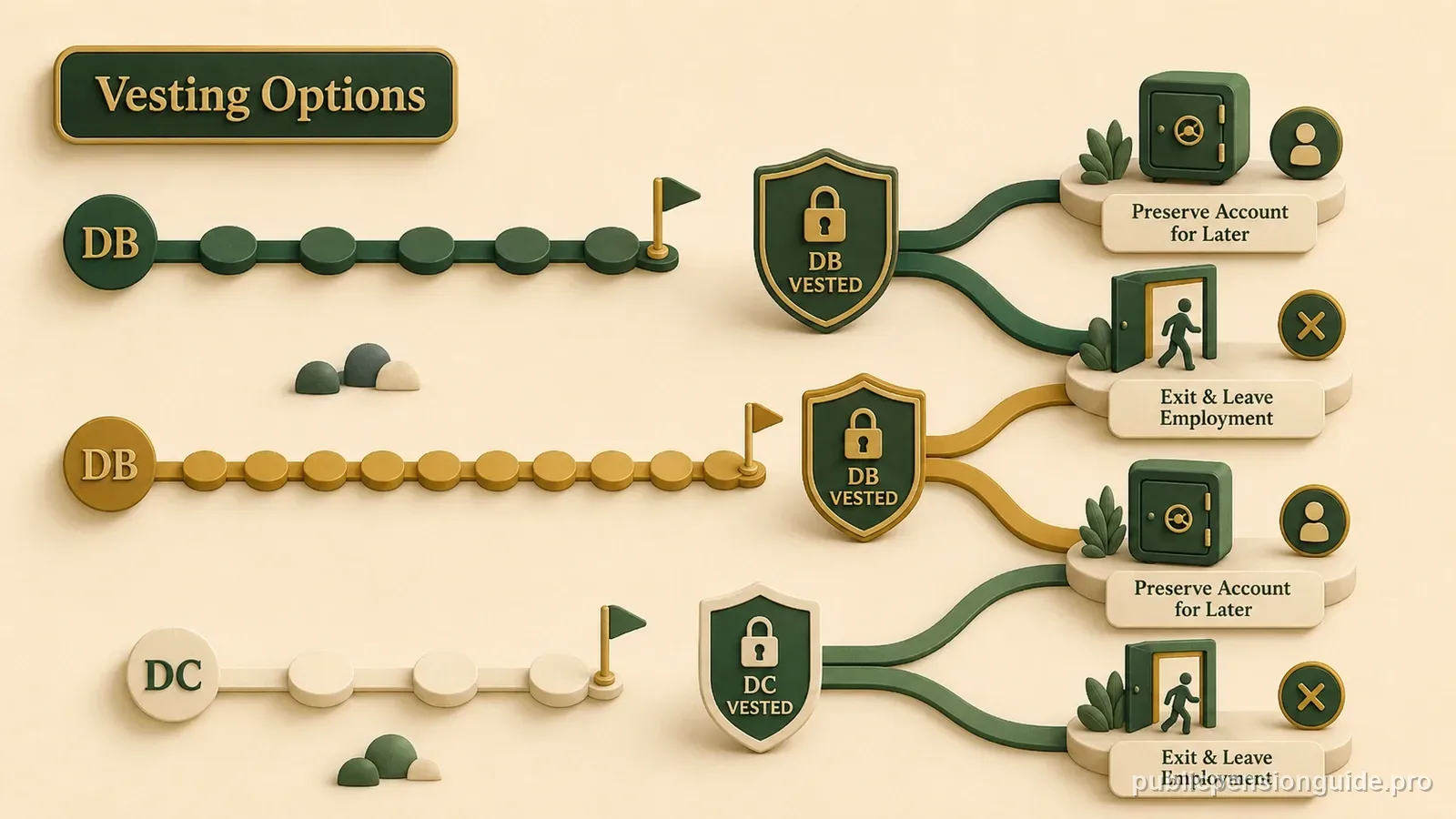
Leaving PSERS-covered work does not automatically mean cashing out. Vested DB members can preserve a future pension, while DC employer money has a separate three-eligibility-point vesting test.Quick facts
- 5 years generally vest Classes T-C and T-D in the PSERS DB Plan.
- 10 years generally vest Classes T-E, T-F, T-G and T-H in the PSERS DB Plan.
- 3 eligibility points vest employer DC contributions for PSERS DC participants.
Defined Benefit vesting depends on the membership class
PSERS DB vesting means a member can terminate Pennsylvania public school employment and retain the right to a future monthly benefit. Classes T-C and T-D generally vest after five years of service with the required qualifying service. Classes T-E, T-F, T-G and T-H generally require ten years of qualifying service, although PSERS also publishes age-based alternatives for members who terminate at the applicable older age with sufficient service.
Once vested, leaving employment does not require an immediate retirement application. PSERS can automatically leave the DB account deferred until the member later applies for a monthly benefit. Deferring can eliminate or reduce early-retirement penalties if the member waits until a normal-retirement point. It can also preserve a death benefit that may be worth more than simply refunding contributions and interest.
The DC component has a separate vesting clock
Class T-G, T-H and Class DC participants are always fully vested in their own DC participant contributions, voluntary after-tax contributions, rollover contributions and related earnings. Employer DC contributions use a separate rule: PSERS says the participant needs three eligibility points, generally one point for each fiscal year in which the participant contributes to the PSERS DC Plan, to vest the employer money and its earnings.
A hybrid member can therefore reach DC vesting before DB vesting. For example, a T-G participant may earn three eligibility points for employer DC contributions but still be short of the ten years generally required for the DB pension. Leaving at that point can preserve the vested DC value while the nonvested DB side follows refund rules. Treat the two components as separate assets when evaluating a job change.
A deferred account still has required-distribution deadlines later in life
PSERS allows vested members to defer the DB pension and, when applicable, delay eligible DC distributions, but federal required-minimum-distribution rules eventually create a deadline. PSERS' current RMD page lists a required beginning age of 73 for people born from 1951 through 1959 and age 75 for people born on or after January 1, 1960, with older birth cohorts using earlier ages.
Deferral should therefore be treated as a planning choice, not permanent inaction. Keep PSERS informed of address and beneficiary changes and revisit the account before the federal required beginning age. A former member who later reaches normal-retirement eligibility should also compare the monthly pension with any available refund choice before giving up a lifetime benefit solely to simplify the account.
Map DB and DC vesting on separate timelines
A T-G or T-H member can have different vesting dates for the two parts of the retirement package. The DB side generally needs ten years, while employer DC contributions vest after three eligibility points. The member's own DC money is always fully vested. A job change after only a few school years can therefore create a vested DC account but no vested DB pension.
For T-C and T-D, the basic DB service test is five years. T-E and T-F generally use ten. The age-based alternatives published by PSERS can matter for late-career entrants. Before assuming an account is nonvested, check both the years-of-service path and the class-specific age-at-termination path.
| Component / class | General vesting |
|---|---|
| DB T-C / T-D | 5 years, with age-based alternatives |
| DB T-E / T-F / T-G / T-H | 10 years, with age-based alternatives |
| Member DC contributions | Always 100% vested |
| Employer DC contributions | 3 eligibility points |
Deferring a vested DB benefit preserves options
A vested former member does not have to start the PSERS pension or request a refund immediately. PSERS can leave the account vested until the member later chooses retirement. Waiting can eliminate an early-retirement reduction and can preserve a death benefit greater than the contributions-and-interest refund. The account is not earning additional service credit, but the member retains the right already earned.
PSERS also notes that some members intentionally refund despite being vested because another state's retirement system may require forfeiture of a prior vested benefit before allowing an out-of-state service purchase. That is a specialized portability issue. A member facing it should obtain the other system's written rule before surrendering a Pennsylvania lifetime benefit merely because a new employer mentions service-credit transfer informally.
| Choice | Primary effect |
|---|---|
| Defer | Preserve future monthly pension and applicable death benefit |
| Start early | Receive monthly pension now with possible reduction |
| Refund | Receive contributions/interest and surrender pension right |
Federal required beginning age eventually limits indefinite deferral
PSERS' SECURE Act page lists current required beginning ages based on date of birth. People born in 1951 through 1959 generally use age 73; those born on or after January 1, 1960 generally use age 75. Older cohorts have earlier ages. The federal rule means a former employee cannot defer retirement assets forever simply because the PSERS account allows postponement.
Keep mailing address, beneficiary information and contact details current during a long deferral. A former employee who moves across states or changes careers can otherwise miss required notices or retirement estimates. Several years before the applicable federal beginning age, request a fresh PSERS estimate and coordinate the DB pension with any DC balance and other retirement accounts.
| Birth period | Required beginning age shown by PSERS |
|---|---|
| Before 7/1/1949 | 70½ |
| 7/1/1949–12/31/1950 | 72 |
| 1951–1959 | 73 |
| 1960 or later | 75 |
Preserve records when changing employers or states
Before leaving a school employer, download the latest Statement of Account and confirm the termination date after the employer reports it. Keep the membership class, service total, beneficiary designation and DC statement together. A future retirement decision can occur decades later, and a clean record makes it easier to resolve a missing service year without relying on an old employer's memory.
If another public retirement system offers service-credit purchase for prior Pennsylvania work, obtain its written conditions before refunding PSERS. Some systems require forfeiture of the prior benefit, while others do not. The decision should compare the Pennsylvania pension value with the cost and benefit of the new system's service purchase, not assume portability always improves retirement income.
| Record | Why keep it |
|---|---|
| Statement of Account | Service, salary, class and beneficiaries |
| DC statement | Vested account value |
| Termination confirmation | Starts distribution/refund processes |
| Other-system rule | Documents any service-purchase requirement |
Checklist before you decide
- Check DB vesting for your exact membership class.
- Check DC employer-contribution vesting separately if you have T-G, T-H or Class DC.
- Compare defer, early pension and refund before making an election.
- Update PSERS address and beneficiary records after leaving employment.
- Calendar your federal required beginning age if you defer long term.
Questions people ask
How many years does it take to vest in PSERS?
For the DB Plan, Classes T-C and T-D generally vest after five years, while Classes T-E, T-F, T-G and T-H generally require ten years. PSERS also publishes age-based alternatives for some classes. The DC side uses different rules, including three eligibility points for employer DC contributions.
Are my PSERS DC contributions always vested?
PSERS says participants are always 100% vested in their own DC participant contributions, voluntary after-tax contributions, rollover contributions and related earnings. Employer DC contributions and their earnings require three eligibility points. That separate rule means a hybrid member can vest in employer DC money before vesting in the DB pension.
What happens if I leave PSERS after I am vested?
You can generally leave the DB account deferred and apply for the monthly pension later, start a reduced pension if eligible, or request a refund and surrender the future pension. Deferral can help eliminate an early-retirement reduction and may preserve a larger death benefit than a contributions-and-interest refund.
Do I keep earning service credit after leaving a vested PSERS account?
No. Vesting preserves service already earned but does not add new credited service after PSERS-covered employment ends. The pension can still become unreduced later because the member ages into a normal-retirement rule, but the credited-service total remains based on service actually earned or validly purchased.
How long can I leave a PSERS retirement account deferred?
PSERS allows deferral, but federal required-minimum-distribution rules eventually require benefits to begin. The current PSERS chart lists age 73 for people born in 1951–1959 and age 75 for people born in 1960 or later, with earlier required beginning ages for older birth cohorts.
Official sources
Sources were reviewed on September 2, 2026. Rules and member records maintained by the retirement system control.
PSERS — Becoming VestedOfficial source ↗PSERS — Vesting / Deferring RetirementOfficial source ↗PSERS — Required Minimum DistributionsOfficial source ↗This article provides general educational information. It is not a benefit determination or financial, tax, or legal advice. Confirm account-specific information with the retirement system.