Bottom line
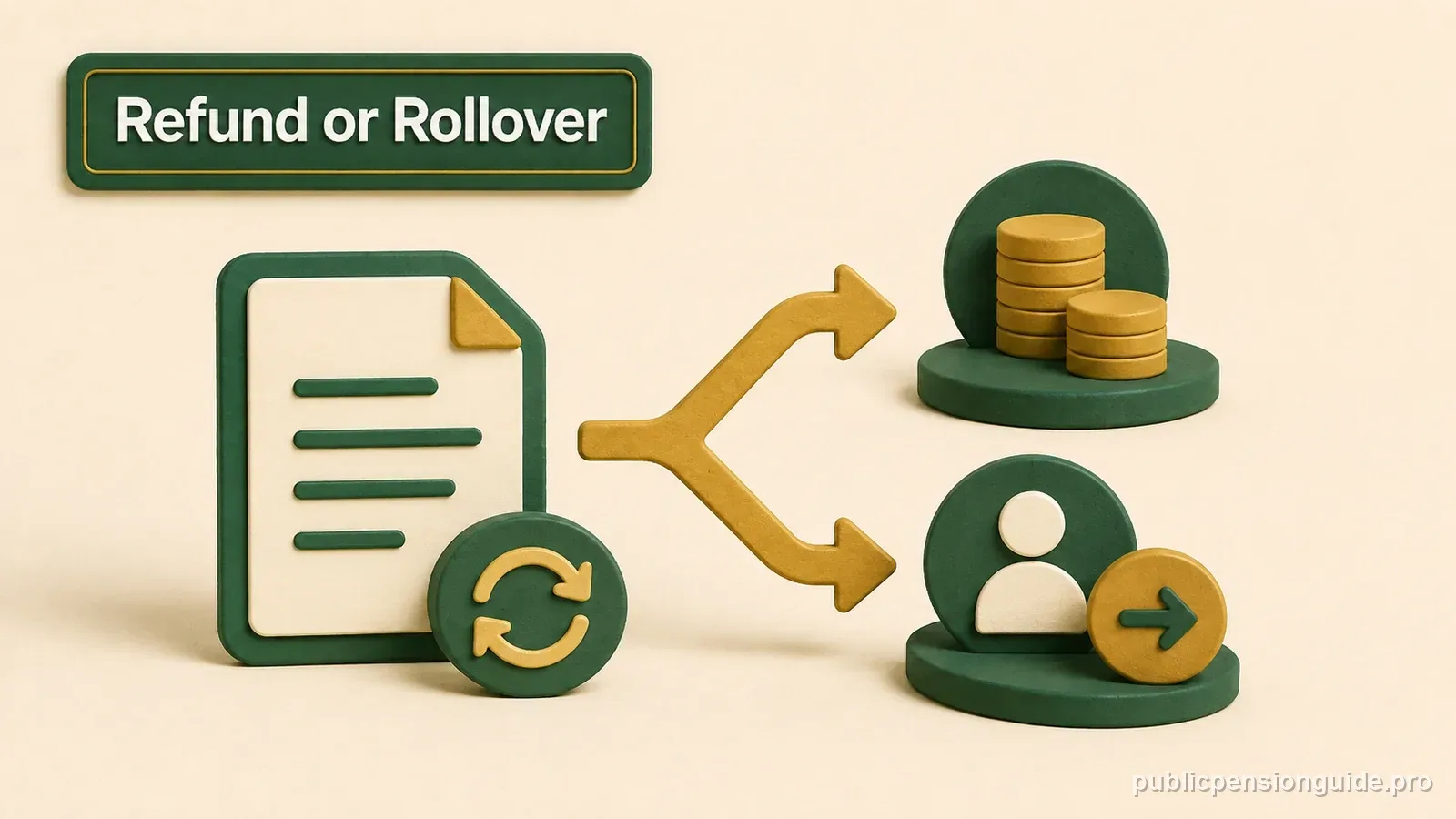
A Pension Plan refund returns employee contributions but gives up related FRS service. Investment Plan members can leave, roll over, or withdraw vested assets after the termination period, but a distribution changes FRS status.Key facts
- 3 full calendar months of termination generally precede a Pension Plan refund or standard Investment Plan distribution.
- 100% of employee contributions are vested in both FRS plans.
- 1 continuous year of later FRS-covered work is generally required before refunded Pension Plan service can be repurchased.
A Pension Plan refund is not the cash value of the pension
Florida law allows a Pension Plan member who has terminated employment with all participating employers for three calendar months to request a refund of employee contributions. Employer contributions are not refundable, and no interest is added to Pension Plan employee contributions. This is not the present value of a vested lifetime pension; a vested member can instead leave the benefit deferred.
Taking the refund forfeits FRS and Health Insurance Subsidy rights tied to the represented service, subject to statutory restoration. MyFRS states that a returning member generally must complete one year of creditable service before repurchasing refunded service and must repay the refund plus interest. The restored service is not automatic simply because the member later returns to an FRS employer.
Investment Plan members have more payout forms, but a rollover is still an FRS distribution
A vested Investment Plan member can leave the account invested, roll eligible money to an IRA or another qualified retirement program, take part or all of the balance, or use an available annuity option. For an ordinary payout, MyFRS requires three complete calendar months after termination from every FRS employer. The termination must be genuine under FRS rules rather than a leave or transfer between covered jobs.
Members who have already reached the Investment Plan’s normal-retirement requirements may have a limited timing exception: MyFRS describes a one-time distribution of up to 10% after one full calendar month of termination, with the remainder available after the additional waiting period. That exception changes timing, not the underlying tax or retiree-status consequences. A direct rollover can defer current federal taxation, but it still counts as an FRS distribution for plan-status purposes.
The safest exit checklist separates taxes, FRS status, and the possibility of returning to public employment
Cash paid directly from a qualified plan can create federal income-tax withholding and possible additional tax, while an eligible direct rollover generally moves money without current taxation. This guide does not calculate individual tax liability. The operational point is to choose the destination before submitting the distribution request. Eligible members should review the current tax notice that accompanies the plan distribution forms.
FRS status is a separate issue. MyFRS says an Investment Plan participant who takes a vested distribution is considered retired, while a Pension Plan refund forfeits represented service until any allowed restoration. A teacher expecting to return to Florida public employment should compare those long-term effects with the convenience of moving money now. A future public-school job can therefore make the exit decision more consequential than it first appears.
Choose among three Pension Plan exit paths before filing a refund form
A departing Pension Plan member can leave contributions and service on deposit, begin an eligible pension, or request a refund after the termination rule is met. The refund is the employee-contribution amount allowed by statute; employer contributions are not refundable and no interest is added to Pension Plan employee contributions. A vested pension can therefore be worth much more than the refund over a lifetime.
If the member is not vested, leaving service on record can preserve a return-to-FRS path. Taking a refund instead waives rights associated with the refunded service. A future repurchase may be possible after one year of later covered service, but the member must repay the refund plus required interest.
| Choice | Primary effect |
|---|---|
| Leave on deposit | Preserve service and deferred rights |
| Start pension if eligible | Monthly benefit begins |
| Refund contributions | Cash employee contributions; service waived |
For the Investment Plan, decide destination and timing before requesting a distribution
The Investment Plan offers account-based choices: leave money invested, take a partial or full distribution, roll eligible assets to another qualified account, or consider an annuity. The standard rule is three full calendar months of termination before distribution. Members who meet normal-retirement requirements can have a limited 10% exception after one full calendar month.
A direct rollover can defer current federal taxation on eligible amounts, but FRS still treats it as a distribution for retiree-status purposes. Confirm the termination date on file and the rollover destination before submitting the request rather than assuming a rollover is neutral under every FRS rule.
| Action | FRS/tax note |
|---|---|
| Leave invested | No distribution yet |
| Direct rollover | Generally tax-deferred; still FRS distribution |
| Cash distribution | Current tax may apply |
| 10% normal-retirement exception | After 1 full calendar month if eligible |
Check what a distribution does to unvested money and future FRS service
An Investment Plan member who leaves before one year may have unvested employer contributions in suspense for up to five years. Taking a distribution of vested money can forfeit that unvested balance and associated service. A transferred Pension Plan value can also carry the longer Pension Plan vesting requirement, so identify all account components first.
For Pension Plan members, a refund gives up the service represented by the refunded contributions and related Health Insurance Subsidy rights until any allowed repurchase is completed. Members who may return to an FRS employer should ask how the transaction affects reemployment and restoration before moving money out.
| Check | Reason |
|---|---|
| Vesting status | Avoid forfeiting unvested employer/transferred amounts |
| Future FRS employment | Distribution can change status |
| Tax destination | Cash vs direct rollover |
| Service restoration | Refunded Pension service requires later repurchase |
Before you act on this
- Verify that your termination date satisfies the FRS three-calendar-month rule.
- Compare the Pension Plan refund amount with the value of leaving a vested pension deferred.
- For the Investment Plan, identify vested, unvested, suspense, and transferred components before withdrawing.
- Choose cash, direct rollover, or leave-in-plan treatment before submitting distribution paperwork.
- If you may return to FRS employment, confirm how the transaction changes retiree status and service-restoration rights.
Frequently asked questions
Can I get a refund of my Florida FRS Pension Plan contributions after quitting?
Yes, after a valid termination from all participating FRS employers for three calendar months, a Pension Plan member may request a refund of employee contributions subject to the plan rules. Employer contributions are not refunded, and the Pension Plan refund does not include interest on the employee contributions. Taking the refund waives rights to the associated service.
Can I roll my Florida FRS Pension Plan refund directly to an IRA?
Eligible retirement-plan amounts can often be rolled to another qualified plan or IRA, but the specific tax treatment depends on the distribution and destination. The FRS refund still gives up the Pension Plan service represented by the refunded contributions. Members should obtain the plan’s current rollover instructions and tax notice before selecting a cash or direct-rollover payment.
How long after leaving an FRS job can I withdraw my Investment Plan account?
MyFRS generally requires three full calendar months of termination from all FRS employment before a standard Investment Plan distribution. A member who has reached normal-retirement requirements may qualify for a one-time distribution of up to 10% after one full calendar month, with the remainder becoming available after the additional waiting period.
Does an FRS Investment Plan rollover count as retirement?
MyFRS states that taking a distribution of vested Investment Plan employee or employer contributions, including a rollover, generally makes the participant an FRS retiree. That status can affect later FRS reemployment or renewed membership. The tax treatment of a direct rollover can still be different from a cash distribution even though both are distributions for FRS purposes.
Can I restore FRS Pension Plan service after taking a refund?
Florida law allows prior refunded service to be purchased again under the applicable restoration rules. MyFRS states that a returning member generally must complete one continuous year of FRS-covered employment before becoming eligible to repurchase the refunded service, and the cost includes the required amount plus interest. The member should request a current calculation after returning.
Where this comes from
Sources were reviewed on September 1, 2026. Rules and member records maintained by the retirement system control.
Florida Statutes §121.091Official source ↗MyFRS — Investment Plan Benefit PayoutsOfficial source ↗MyFRS — FAQsOfficial source ↗General educational information only — this is not a formal benefit determination, nor financial, tax, or legal advice. Verify anything account-specific with the retirement system itself.