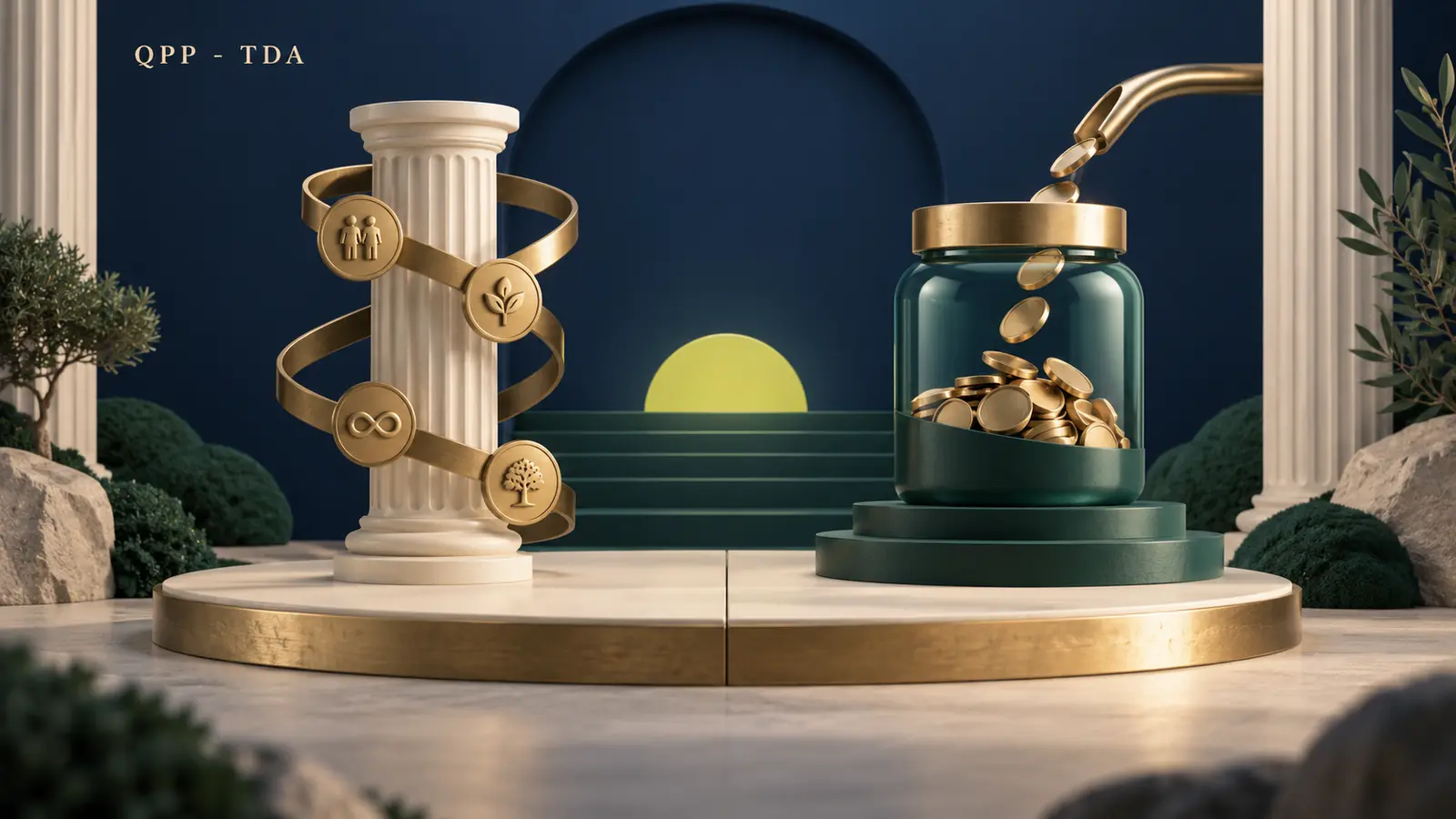
Bottom line
The QPP (Qualified Pension Plan) is your mandatory NYC teacher pension — a lifetime benefit set by a formula. The TDA (Tax-Deferred Annuity) is a voluntary 403(b) you fund yourself, with a Fixed Return Fund that pays a state-set rate (7% for UFT members) plus variable investment options.Key facts
- QPP: required, employer-backed, formula-based lifetime pension
- TDA: optional, self-funded 403(b), balance is yours
- The TDA Fixed Return Fund rate is 7% for UFT members, set by law
Two accounts, two jobs
When you join the NYC Teachers' Retirement System you are automatically in the Qualified Pension Plan, or QPP. This is the pension: you and the city contribute, and at retirement it pays a monthly benefit for life based on your tier, your years of service, and your final average salary. You cannot opt out of it.
The Tax-Deferred Annuity, or TDA, is entirely separate and entirely optional. It is a 403(b) plan: you choose to divert part of your paycheck into it before tax, you choose how it is invested, and the balance belongs to you. The city does not contribute to your TDA.
The QPP in more detail
The QPP is a defined benefit plan. Its value does not depend on markets — it depends on the formula. For most current hires (Tier 6, the "63/5" plan), that means a benefit equal to a set percentage per year of service, applied to the average of your highest three years of salary, payable unreduced at 63.
Your required QPP contributions are a percentage of your salary set by your tier (for Tier 6, between 3% and 6% depending on your earnings level). Those contributions, plus the city's much larger share and investment returns, fund the guaranteed benefit.
The TDA and its Fixed Return Fund
The TDA's best-known feature is the Fixed Return Fund. By New York law it credits a guaranteed annual rate — 7% for members of the United Federation of Teachers, and 8.25% for certain other members such as supervisors. That rate was lowered from 8.25% to 7% for most members in 2009 and has held since.
A guaranteed 7% is unusually generous, which is why many NYC teachers contribute heavily to the TDA. The TDA also offers variable "Passport Funds" (stock, bond, and balanced index options) for members who want market exposure instead of, or alongside, the fixed rate. The money in the Fixed Return Fund is pooled with the pension fund for investment purposes, but your account is still tracked as your individual balance.
| QPP (pension) | TDA (savings) | |
|---|---|---|
| Participation | Mandatory | Voluntary |
| Who contributes | You and the city | You only |
| Benefit type | Lifetime monthly formula | Account balance you draw down |
| Investment risk | None to you — it is guaranteed | Yours (except the Fixed Return Fund rate) |
| Fixed Return Fund rate | n/a | 7% (UFT); 8.25% (certain others) |
How to think about the two together
Fund the QPP fully — you have no choice, and that is fine, because it is the stable floor of your retirement income. Then decide how much of your remaining savings capacity to route into the TDA. For many NYC teachers the Fixed Return Fund is the single best low-risk option available to them, better than most outside bond funds.
At retirement the two accounts are handled separately. The QPP becomes a monthly pension (with survivor options you elect). The TDA can be left invested, withdrawn, rolled over, or converted into a TRS annuity. You do not have to make the same choice for both.
- Confirm your QPP tier and contribution rate on your TRS statement.
- Check whether your TDA Fixed Return Fund rate is 7% or 8.25%.
- Decide a TDA contribution rate and increase it when you get a raise.
- Keep QPP and TDA retirement decisions separate — they do not have to match.
What happens to each account when you leave
If you resign before you are eligible to retire, the QPP and TDA are handled separately. A vested QPP account can be left in place for a future pension; an unvested one can be refunded. The TDA balance is always yours — you can leave it invested with TRS, roll it to an IRA, or withdraw it (with tax consequences).
Many departing NYC teachers leave the TDA with TRS specifically to keep access to the Fixed Return Fund rate, which is hard to match elsewhere. Confirm the current rules for non-active members before deciding.
Before you act on this
- Confirm your QPP tier and contribution rate on your TRS statement.
- Check whether your TDA Fixed Return Fund rate is 7% or 8.25%.
- Set a TDA contribution rate and raise it with each salary increase.
- Keep QPP and TDA retirement elections separate.
- Before leaving NYC teaching, check the rules for keeping your TDA with TRS.
Common questions
What is the difference between the QPP and the TDA?
The QPP is your mandatory NYC teacher pension — a lifetime monthly benefit set by a formula. The TDA is a voluntary 403(b) savings plan you fund yourself and invest, and the balance belongs to you.
What is the TDA Fixed Return Fund rate?
By New York law it is 7% per year for United Federation of Teachers members and 8.25% for certain other members. The 7% rate has been in place since 2009.
Does the city contribute to my TDA?
No. The TDA is funded only by your own voluntary contributions. The city contributes to the QPP pension, not the TDA.
Sources for this page
Sources were reviewed on September 9, 2026. Rules and member records maintained by the retirement system control.
TRS NYC — Your Tax-Deferred Annuity ProgramOfficial source ↗TRS NYC — Your TRS benefits in brief (Tier VI)Official source ↗NYC BERS — Tier 6 (63/5) summary plan description (PDF)Official source ↗General educational information only — this is not a formal benefit determination, nor financial, tax, or legal advice. Verify anything account-specific with the retirement system itself.